AI Is Changing Branding. Here's What That Actually Means
The Conversation Has Shifted
For a while, the loudest question in design was whether AI would replace designers. That debate hasn't fully disappeared, but it has become less interesting. The more useful question, the one we're actually sitting with in our agency, is this: what does it mean to build a brand when the tools can build too?
That shift in framing changes everything. It moves the conversation from threat to craft. And it opens up something worth exploring.
What AI Is Actually Doing to Branding
AI isn't just speeding up production. It's quietly changing what brand identity is.
For decades, a brand lived in a style guide. A fixed set of rules: colors, typefaces, logo usage, tone of voice. Designers executed within those rules. Agencies maintained them. Clients tried to follow them.
That model made sense when brands communicated through a limited number of controlled touchpoints. But the landscape has changed. Brands now exist across dozens of channels, formats, and contexts. Each with different demands, audiences, and speeds of iteration.
Static rules struggle to keep up. Systems don't.
From Assets to Systems
The brands we find most interesting right now aren't just looking good, they're behaving well. They feel coherent across a campaign, a website, a social post, and a packaging label, without any of it feeling forced. That coherence isn't accidental. It comes from thinking in systems rather than individual assets.
Coca-Cola is one of the clearest examples of this shift. In 2025, the company unveiled Project Fizzion, a design intelligence system built with Adobe that translates brand guidelines into adaptive, machine-readable assets. As designers work inside familiar tools like Illustrator and Photoshop, Fizzion learns from their decisions and encodes that creative intent into something it calls a StyleID: a set of brand rules that can then generate hundreds of localized campaign variations automatically, while staying precisely on-brand. The goal, in their words, is to free creatives to focus on storytelling rather than formatting.
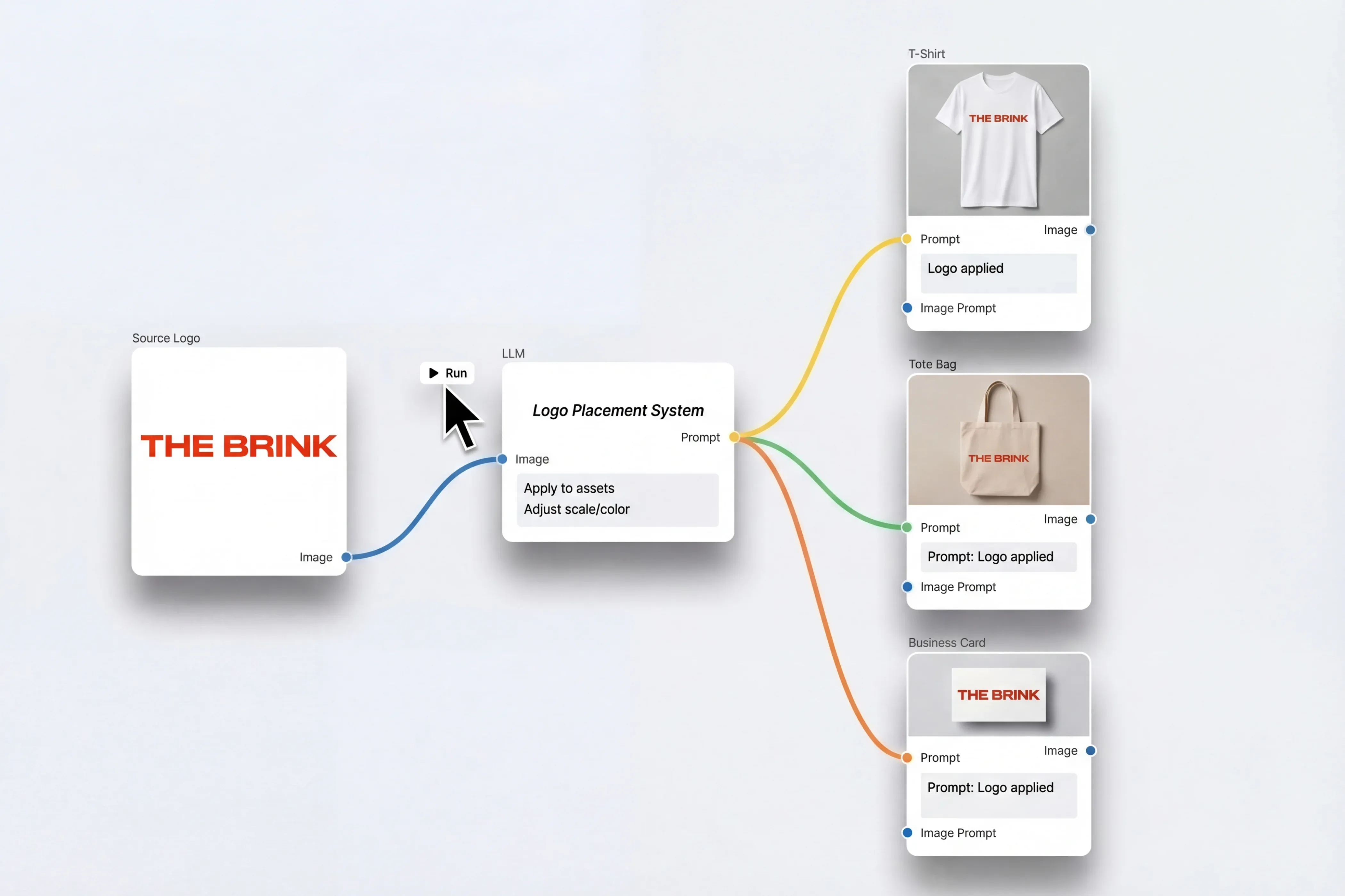
One way to think about what this looks like in practice is a node-based brand system. This is a network of connected “rules” and “parameters” that define how a brand behaves, rather than just what it looks like. Instead of a static style guide, you build a live architecture: nodes for color logic, typography, tone of voice, and platform context, all connected so that a change in one place flows through the entire system automatically. The result is a brand that can generate consistent output at scale, without a designer having to manually touch every asset.
That's not AI replacing designers. That's AI doing what a system should do: holding the rules so the people can focus on the thinking.
The Bar Is Rising. Fast.
Here's the part brands often underestimate: because AI makes content generation so accessible, audiences are increasingly exposed to more of it. And that raises expectations, not lowers them.
When Coca-Cola released an AI-generated Christmas ad in 2025, reactions were split. Some found it charming, others felt it lacked the emotional warmth the brand is known for. The conversation wasn't about whether they used AI. It was about whether the result felt like Coca-Cola.
McDonald's ran into something similar and it sparked an interesting conversation. McDonald's Netherlands released an AI-generated Christmas ad that divided audiences: some found it a bold creative experiment, others felt the visuals didn't quite land emotionally. The spot was ultimately pulled, but what followed was a wide-ranging public debate about AI's role in brand storytelling, exactly the kind of conversation that pushes the industry forward. Whatever you think of the execution, it puts the question on everyone's lips: what do we actually expect from brands in the age of AI?
Both cases point to the same thing: in a world where AI-generated content is everywhere, the standard for what a brand puts out hasn't dropped. If anything, it's gone up. Audiences have become faster at sensing when something feels hollow, even if they can't always explain why.
What This Means for the Designer's Role
If AI can handle more of the execution, the value of a designer shifts upstream toward defining the logic, the parameters, the why behind the system. The designer becomes less of an executor and more of an architect. Someone who encodes what a brand is, so it can behave consistently even when no one is watching.
That's a harder job in some ways. And a more interesting one.
What We're Still Figuring Out
We won't pretend we have all the answers. The tools are evolving fast. What's true about AI in branding today might look different in six months. And some of the most important questions around authorship, authenticity, and what it means for a brand to feel human don't have clean answers yet.
What is clear is that brands can no longer treat AI as an optional experiment. It's becoming part of the infrastructure of how identity gets expressed at scale. The question is no longer whether to engage with it, but how thoughtfully you do.
The Brink Perspective
This is exactly the kind of challenge we work on with our clients, and it gives us energy!
Building a brand system that can scale with AI, without losing the things that make it feel human, requires both strategic clarity and the right creative architecture. It means understanding what a brand truly is at its core, and designing the rules that let it behave consistently across every output, every channel, every context.
That's where we come in. Whether you're a brand trying to figure out where AI fits in your identity, or a business that wants to build something more resilient than a style guide, we'd love to have that conversation.
Curious what this could look like for your brand? Let's talk.

More Than a Car: Designing the Spyker Lifestyle Online
Read this article

Why Work Still Feels Harder Than It Should and How AI Can Help
Read this article
Seeing the World Through a Chicken's Eyes
Read this article